
Broadway Billboard: ‘To the Avengers of the New World’
OVERVIEW
https://socratessculpturepark.org/wp-content/uploads/2020/02/Dread-Scott-Press-Release-9.18.19.pdfPress Release–
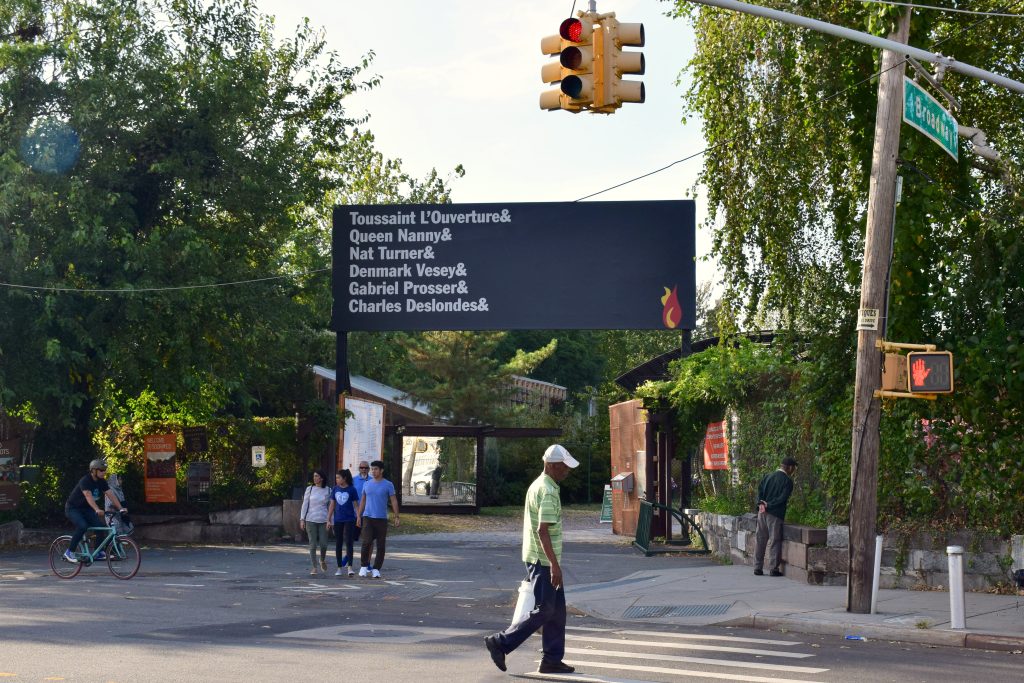
Dread Scott commission for the Park’s Broadway Billboard, ‘To the Avengers of the New World,’ is a thoughtful provocation to consider the impact and legacy of rebellions by enslaved peoples. The work is presented in the context of the http://400yearsofinequality.org/400 Years of Inequality educational initiative – which aims to engage communities in addressing historical and contemporary racial inequalities and fighting for a more just future for all.
On Saturday, October 12 from 12-3pm the Park will present https://socratessculpturepark.org/program/400-years-of-inequality-a-peoples-observance/400 Years of Inequality: A People’s Observance For A Just Future – a free public event in recognition of the anniversary of the first Africans sold into bondage on North American soil in 1619. Rooted in this historical framework and reinforced by the themes of Scott’s Broadway Billboard, social-practice artist and Socrates Board Member, https://elcleonardo.com/Shaun Leonardo, will lead a discussion oriented towards action on the topic of equality.
Rendered starkly in black and white, Scott’s Broadway Billboard composition features a list of names – each ending in an ampersand. For the average viewer, “Nat Turner” is probably the most recognizable name on the list. Those familiar with his story may make the connection that the other individuals on the list were leaders of rebellions by enslaved peoples. All lived in the 18th and early 19th centuries in the United States or the Caribbean.
The flame at the bottom right hand corner of the billboard suggests both the intensity and power of these leader’s battles against oppression and memorializes their stories. As a whole, Scott’s piece is aesthetically direct while avoiding pedantry and encourages a deeper understanding of the history pertaining to these figures.
The thrust of historical knowledge as a form of self-empowerment is characteristic of Scott’s practice. He has noted that his very name is a reminder of Dred Scott – an enslaved African American who sued for his freedom but lost the case in the Supreme Court in 1857. The Court’s ruling stated that “[black people] had no rights which the white man was bound to respect,” and laid the groundwork for similarly racist arguments ¬that still persist today. Scott’s work pursues radical forms of social justice in this legacy.
LEARN MORE
http://wikipedia.org/wiki/Toussaint_LouvertureTOUSSAINT L’OUVERTURE
Toussaint L’Ouverture was a military commander and politician in the Haitian Revolution. He was born into slavery in Saint-Domingue, current-day Haiti, which was under French colonial rule at the time, but was freed sometime before the Revolution started. He joined the struggle during the slave rebellion in 1791 and quickly became a leader of the independence movement. His victories effectively gave him control of the colony and he declared a new constitution abolishing slavery in 1801. The following year, Napoleon’s troops captured him, and imprisoned him in France where he died in 1803.
http://wikipedia.org/wiki/Nanny_of_the_MaroonsQUEEN NANNY
Queen Nanny was a late 17th and early 18th-century leader of a group of escaped slaves known as Jamaican Maroons. Their community was even called Nannytown after her. Widely believed to have been born in Ghana, Queen Nanny was enslaved in Jamaica before escaping into the wilderness with her brothers. Her position as a leader was strengthened by her prestige as a spiritual authority in the religious practice of Obeah, a set of Afro-Caribbean practices with West African influences. In 1733, she died in battle fighting repressive British colonial forces.
http://wikipedia.org/wiki/Nat_TurnerNAT TURNER
Nat Turner was born into slavery on a Southampton County Virginia plantation. Introduced to religious teachings, he became a passionate preacher, with spiritual beliefs guiding his actions of self-emancipation. He led the most well-publicized slave rebellion in the United States in August of 1831, which resulted in the death of dozens of plantation owners. The uprising spread to nearby towns, recruiting dozens of slaves and free blacks until they confronted and stopped by a white state militia of thousands. While Turner was able to hide for several months, he was eventually discovered, found guilty of insurrection, and executed.
http://wikipedia.org/wiki/Denmark_VeseyDENMARK VESEY
Denmark Vesey was a self-educated skilled carpenter and insurrection leader. Born in the former Danish colony of St. Thomas, he was enslaved by a sea merchant for years before arriving in Charleston, South Carolina. In 1799 he bought his freedom with the proceeds of a street lottery win. He became a co-founder and leader in the African Methodist Episcopal Church, which served as a platform for organizing a rebellion of former slaves and free blacks. After the plan was exposed, Vesey was arrested, charged and executed by the state.
http://wikipedia.org/wiki/Gabriel_ProsserGABRIEL PROSSER
Gabriel Prosser was a leader in the 1800 Richmond, Virginia slave uprising, which is estimated to have involved thousands of slaves and free blacks along with the cooperation from sympathetic Quakers, Methodists and Frenchmen. Born into bondage, Gabriel was nonetheless literate and skilled in the trade of blacksmithing. The revolt was thwarted by rainstorm and the state’s discovery of the plan. Gabriel was subsequently arrested, tried and executed along with dozens of compatriots.
http://wikipedia.org/wiki/Charles_DeslondesCHARLES DESLONDES
Charles Deslondes was a leader of the 1811 German Coast Uprising, the largest slave rebellion in United States history. Born on a plantation in the Territory of Orleans, Louisiana, he worked as an overseer at the time of the uprising. He led slaves and maroons in a revolt against plantation owners as they marched towards New Orleans. White militias suppressed the movement by killing, torturing and executing participants as a warning to other would-be leaders.
Dread Scott drew inspiration from the German Coast Uprising for http://slave-revolt.com/‘Slave Rebellion Reenactment’ – a performance involving 500 black re-enactors in period dress, that took place in New Orleans from November 8-9, 2019.