Yantra/Bloom (32°N)
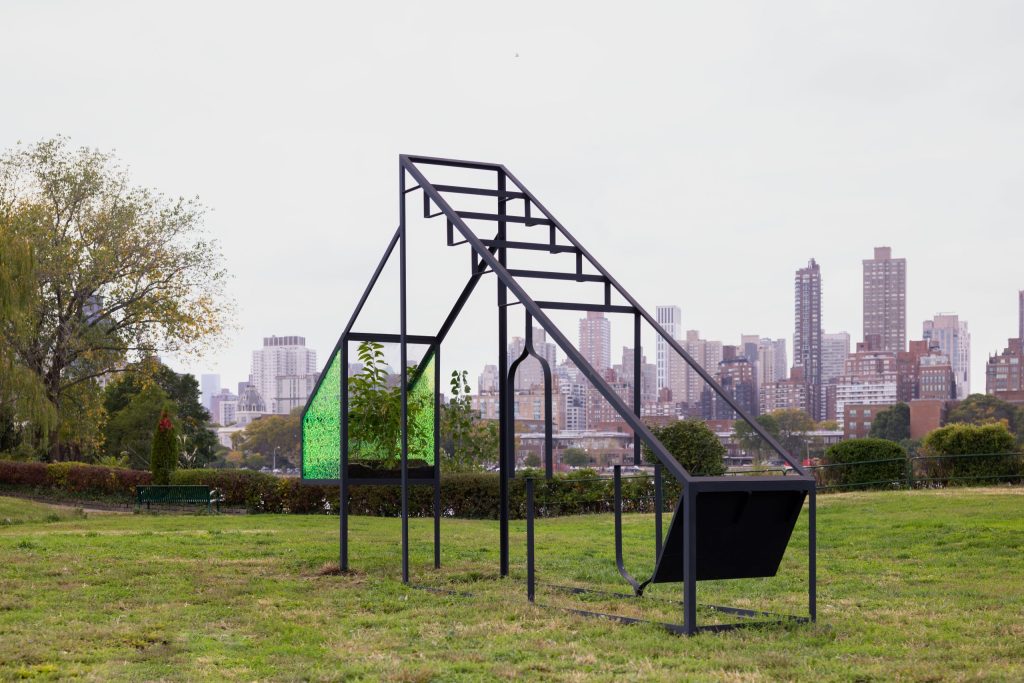
Yantra/Bloom (32°N) draws inspiration from the Samrat Yantra sundial at Jantar Mantar in Delhi, a site steeped in both scientific significance and contemporary political resonance. Oriented towards Palestine, with its gnomon angled at 32°N, the sculpture evokes themes of solidarity, protest, time, and diasporic movements. Within the structure, a greenhouse nurtures two night-blooming jasmine (Raat Ki Rani) plants, whose fragrant blossoms, native to South Asia, invoke a sensory connection to place and memory.
The fluorescent green lattice screens that encase the plants allude to traditional South Asian jaalis, though their patterns are intentionally “glitched,” symbolizing fragmented identities and histories shaped by migration and colonial legacies. The act of releasing scent—an experience unbound by borders—serves as a poetic metaphor for diaspora and the fluidity of cultural exchange.
Notice the mirror positioned at the opposite end of the structure, reflecting light into the greenhouse at key intervals, evoking the celestial precision of the sundial while highlighting the interplay between the scientific and the spiritual. An incomplete staircase within the structure casts an ephemeral shadow, gesturing toward aspirations of transcendence and collective resistance. Hazarika’s work critiques the reductive notion of “invasive species,” reframing it as a complex narrative of survival, adaptation, and resilience.
Digital Media
Alongside Yantra/Bloom (32°N), Utsa Hazarika presents Where Jantar Mantar Was Known For All Kinds of Protest, a sound piece with audio research featuring protest movements in India, with excerpts from Indian journalist Ravish Kumar, protestors in Delhi, student activists, and political prisoner Umar Khalid.