Healing Landscapes
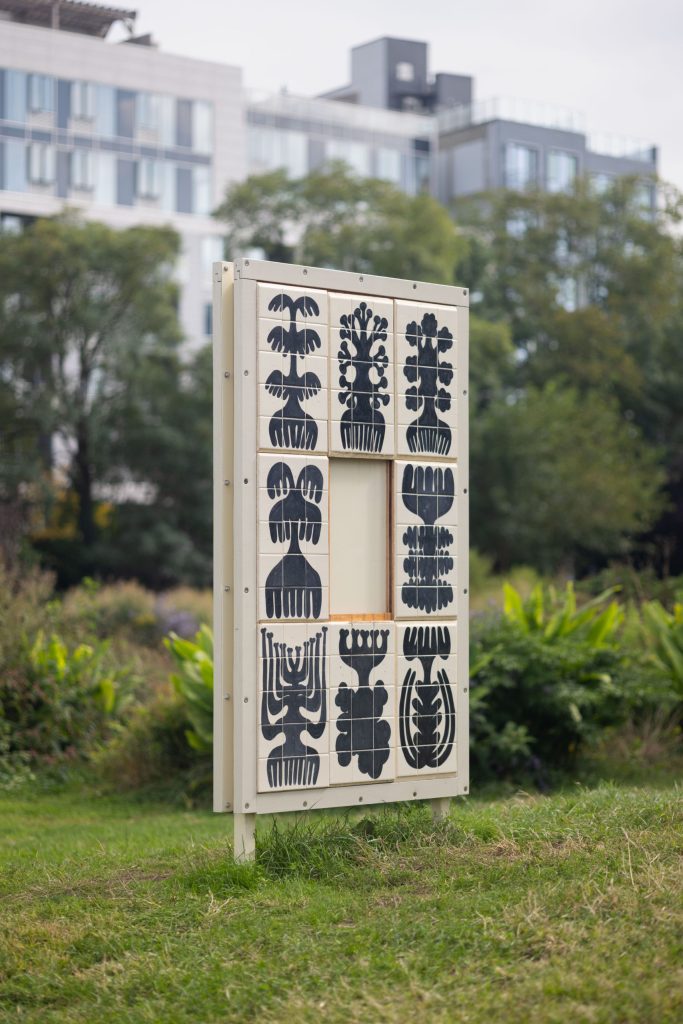
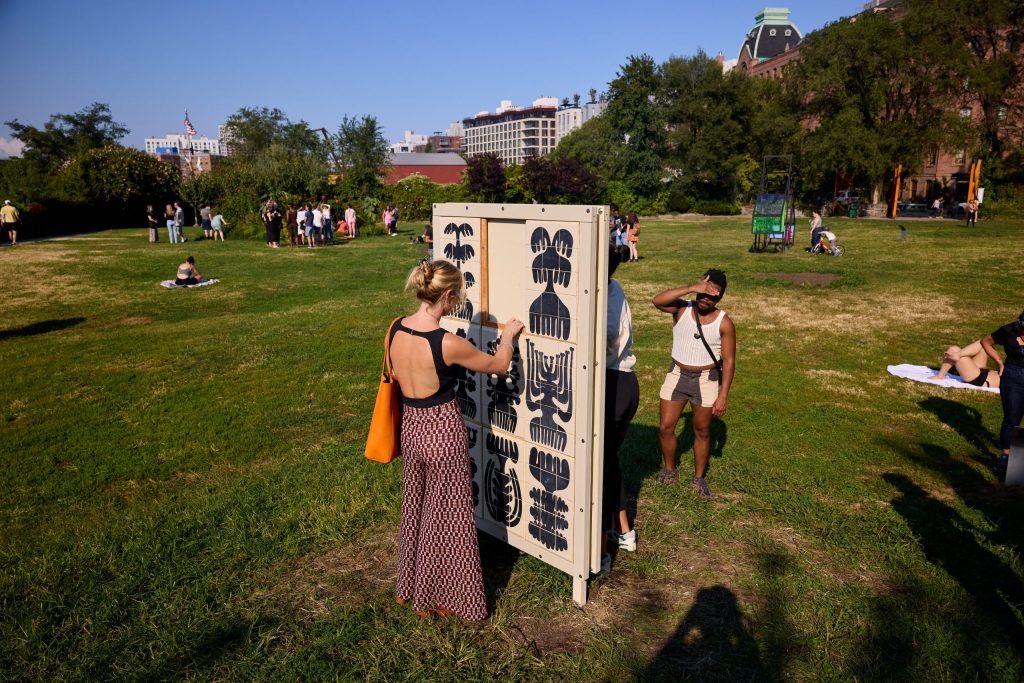
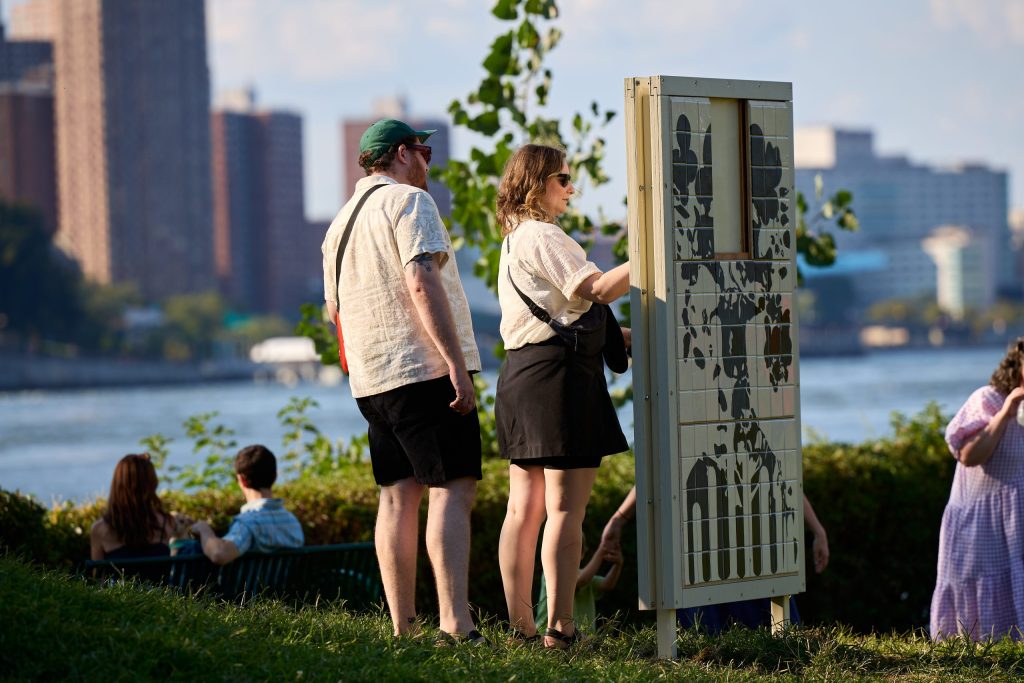
Healing Landscapes is a two-sided interactive “play space” for conversation, education, and reflection on the ideals of social environmentalism. Each side has a unique composition that is designed to be shifted, altered, and transformed, inviting the creation of new visual realities. Using ceramic tiles to create modular canvases, the sculpture presents two distinct landscapes: Ghetto Ecosystem and Subtly Natural.
Ghetto Ecosystem features abstract figures that resemble dendrological forms like trees and roots alongside natural hairstyles found within Black culture, and symbolic “hair picks,” fusing cultural and ecological references. Subtly Natural is a conglomerate abstracted (terra)form, representing biodiversity and serving as an ode to the complexities surrounding “invasive species,” such as the spotted lanternfly, and the beauty that arises from cultural fusion. Together, these works explore how theories, histories, and so-called facts are framed, by whom, and how these framings shape our understanding of ecological identity.
Media
Gabrielle Ione Hickmon interviews Nala C. Turner for the podcast “Working Process.” Listen to an excerpt about Healing Landscapes below. For the full episode, visit https://www.workingprocess.xyz/p/nala-c-turner-ceramics-working-process” HERE
Transcript
Nala C. Turner, 24:55
I constructed that recently as a 2024 Socrates Sculpture Park fellow. I’m fascinated by theories, history and fact and how those things are framed. Who’s doing the framing, how these factors affect our interpretation of ecological identity? The piece explores both the legacy and struggle for economic, social and environmental equality, and that – how that is translated into modern day understanding of biocultural diversity.
So it’s like a six and a half, roughly by three and a half foot, dual sided interactive sculpture. And it has images on either side which can be shifted and altered and transformed. And I think, you know, the piece in itself was created with the intention of fostering communal engagement. You know, I came from Queen City was really in awe of how Nekisha invited us to work as a community.
And I wanted the, even the, the observing or the interaction with my work to be communal as well. So it invites the audience to interact with the modular canvas, asking them to alter and shape the visual reality based on their own unique perceptions. Right? And so while it’s important to know that the work isn’t able to really be fully transformed or shifted alone by one person, it’s pretty heavy and it’s intentionally meant to have collective participation.
So it highlights a fundamental truth that whatever we do in life can’t be achieved in isolation. And I feel like it’s meant to be a larger reflection of our interconnectedness and inviting viewers to experience beauty and the challenge of collective transformation. Which I think I’m always intrigued by because there’s so much not just in black community, but there is so much misunderstanding of separation that we do as a definitely as a nation, but for sure as a world.
And I think there’s so much space that can be done through curiosity and inquiry of what does it mean, actually to allow for the interconnectedness that makes us more powerful as a race of humans, rather than the separation that so many people seek.
About the Artist